

The Quietest Mental Health Practice We Know
This article has been written in collaboration with Kristin Kroll, PhD of Little Dove Psychology. She can be reached at (512) 240-2633 and www.littledovepsychology.com.
Sit Down, Pick Up a Tile, Stay an Hour
For Mental Health Awareness Month — a love letter to the table, and the research behind why gathering at one might be doing more for you than you think.
May is Mental Health Awareness Month. You'll see plenty of posts this month about therapy, journaling, breath work, sleep — and all of those matter. We want to add one practice to the list that doesn't get talked about enough: gathering at a table.
Specifically, gathering regularly. With the same handful of women. Around something to do with your hands.
That, it turns out, is a mental-health practice with a quietly impressive evidence base.
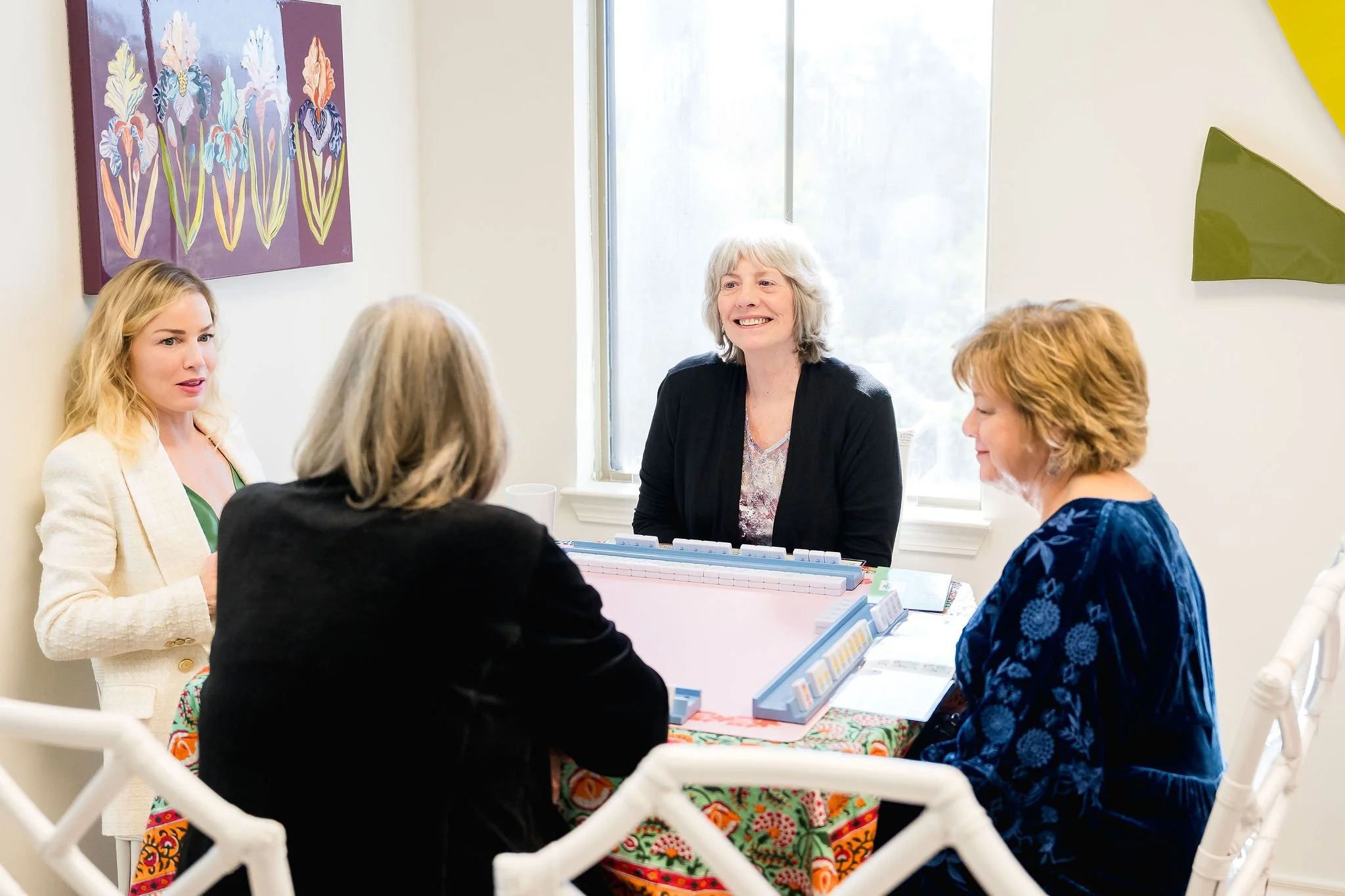
We didn't build Mahj House as a cognitive intervention. We built it as a place Austin women would want to come back to. But the more we watch what actually happens at our tables, the more we see the overlap with what the research describes.
The loneliness math
In 2023, U.S. Surgeon General Dr. Vivek Murthy published an advisory called Our Epidemic of Loneliness and Isolation. The headline finding: chronic loneliness raises the risk of premature death by an amount comparable to smoking up to 15 cigarettes a day. It increases heart disease risk by 29%. Stroke risk by 32%. And among older adults, chronic loneliness raises dementia risk by approximately 50%.
We are, statistically, in a connection deficit. More of us live alone, work alone, scroll alone, and end Sundays without having looked another adult in the eye for more than a handshake.
Mahj House was built as one quiet, beautiful answer to that.
"Loneliness raises premature mortality risk equivalent to smoking up to 15 cigarettes a day." — U.S. Surgeon General, 2023
What the research says about mahjong
It would be easy to wave our hands and say "mahjong is good for your brain" without knowing whether that's actually true. The honest answer: a growing body of research suggests it really is, and meaningfully so.
A 2024 scoping review in The Journal of Prevention of Alzheimer's Disease synthesized 53 studies on mahjong and aging adults. The pattern across the literature is consistent: regular mahjong play is associated with better cognitive performance and a reduced likelihood of mild cognitive impairment. A 12-week intervention study in adults with MCI showed measurable gains in executive function. Other studies have linked it to improvements in memory and reductions in depressive symptoms.
A 2019 University of Georgia study makes the depression finding concrete. Researchers followed nearly 11,000 adults and found that those who played mahjong regularly had measurably lower depression scores than those who did not. The effect held after controlling for age, income, and education. Mahjong didn't cure depression. It just consistently showed up alongside less of it.
The researchers are appropriately careful — mahjong isn't a cure for anything, and the evidence base is still maturing. But the signal is there: a game that asks you to plan, count, remember, read faces, and laugh — all at once, for an hour or two — does something for the mind that scrolling does not.

Mahj House Austin is “the first social center of its kind in the state capital.” — Texas Monthly
Why the social part might matter most
Here's the piece of the research we find most interesting. The benefits of mahjong are not really about the tiles. They're about the table.
Neuroscientists have a name for what's happening: combined cognitive and social engagement. Most brain-training apps fail because they isolate one half of the equation — you sit alone with a screen, your brain works, your spirit does not. Most social activities fail the other way — you connect, you laugh, but your mind is on idle. Mahjong refuses both shortcuts at once.
When you sit down for a hand, you have to be present. You have to pay attention. You have to read three other people. You laugh. You wait your turn. You apologize for the bingo and accept the trash talk. You stay for an extra hand. You walk out into the parking lot still talking.
Nearly every modern mental-health framework — from cognitive behavioral therapy to positive psychology to the social-prescribing models being studied in the UK — circles back to the same pillars: connection, presence, ritual, mastery. Mahjong, played in person, quietly hits all four.
What this looks like at our tables
We didn't build Mahj House as a cognitive intervention. We built it as a place Austin women would want to come back to. But the more we watch what actually happens at our tables, the more we see the overlap with what the research describes.
Our weekly Open Tables are the centerpiece. The same women come back. They start as strangers. By month three, they're texting each other on Tuesday mornings. By month six, they're traveling together. The tiles are the excuse. The circle is the thing.
If May is the month you've been quietly thinking, I should do something for myself, I just don't know what — try this. Drop into an Open Table. Bring a friend, or come solo. Stay an hour. See if the feeling you walk out with isn't a little different from the one you walked in with.
See this week's Open Tables and book a seat at mahjhouseaustin.com.
A note, with care
If you are struggling with your mental health beyond what a good evening with friends can hold, please know that mahjong is not a substitute for professional support. We love this game and what it does for our community, but a therapist, a doctor, or a crisis line can do things we can't. If you are in real distress, please reach out — to someone you trust, to your provider, or to 988, the U.S. Suicide and Crisis Lifeline.
And if you've been waiting for a quiet sign that your evenings deserve more than another night on the couch — let this be one. Come sit with us. We've saved you a seat.
Sources cited
U.S. Surgeon General, Our Epidemic of Loneliness and Isolation (2023): hhs.gov/surgeongeneral
Cheng et al., "Does Playing Mahjong Benefit Older Individuals? A Scoping Review," The Journal of Prevention of Alzheimer's Disease (2024): link.springer.com/article/10.14283/jpad.2024.102
Zhang et al., "Playing Mahjong for 12 Weeks Improved Executive Function in Elderly People With Mild Cognitive Impairment": PMC7120035
Wu et al., "Mahjong Playing and Depressive Symptoms Among Middle-Aged and Older Adults," Social Science & Medicine (2019): sciencedirect.com
Frontiers in Public Health, "Longitudinal associations between the frequency of playing Mahjong and cognitive functioning among older people," CLHLS 2008–2018: frontiersin.org
